How to Shop Safely on Amazon in 2026: Complete Buyer Guide
Learn how to shop safely on Amazon in 2026 by checking sellers, reviews, prices, payment methods, return policies, account security, and common scam warning signs
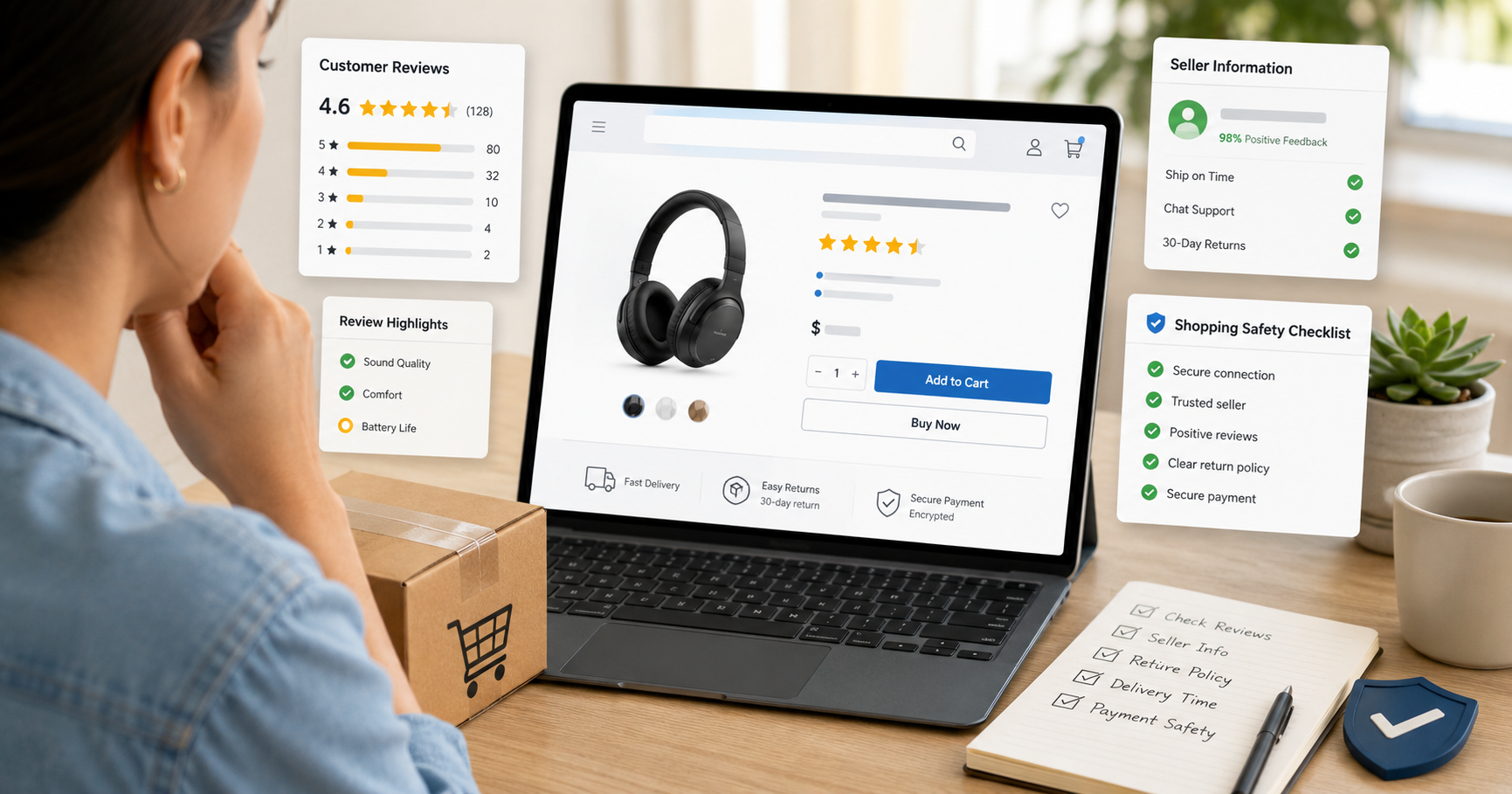
How to Shop Safely on Amazon in 2026: Complete Buyer Guide
Amazon gives buyers access to millions of products from major brands, independent businesses, and third-party marketplace sellers. This wide selection can make online shopping convenient, but it also means buyers should carefully review the product, seller, price, delivery terms, return policy, and payment process before placing an order.
Learning how to shop safely on Amazon in 2026 is not only about avoiding obvious scams. It also involves choosing the correct product variation, understanding who is selling and shipping the item, protecting your Amazon account, reading customer reviews critically, and keeping proper order records.
This guide provides practical Amazon shopping safety tips that can help buyers make more informed purchasing decisions and respond appropriately when an order does not go as expected.
Is It Safe to Shop on Amazon in 2026?
Amazon provides account-security tools, order tracking, customer-support options, return procedures, seller information, and buyer-protection processes. However, no online marketplace can remove every possible risk.
Buyers still need to confirm that they are using the correct Amazon website or official app, review the complete listing, check the seller, avoid suspicious payment requests, and understand the return conditions before ordering.
A safe Amazon purchase normally depends on four factors:
- The authenticity and suitability of the product
- The reliability of the seller
- The security of the payment and account
- The availability of delivery, return, refund, and support options
1. Use the Official Amazon Website or App
Begin your shopping journey through the official Amazon website or the official Amazon mobile application. Be cautious when clicking links from unexpected emails, text messages, social-media posts, online advertisements, or messaging applications.
Scammers may create websites that resemble Amazon login pages, product listings, order notifications, or customer-support pages. Their goal may be to collect your password, payment information, gift-card number, or personal details.
Before signing in or entering payment information:
- Check the website address carefully.
- Look for misspellings or unusual characters in the domain.
- Avoid opening unexpected attachments.
- Do not enter your password through a link that feels suspicious.
- Open Amazon independently and check your account for the claimed order or alert.
An encrypted website address beginning with HTTPS is important, but HTTPS alone does not prove that a website is genuine. Scam websites may also use encrypted connections.
2. Protect Your Amazon Account
A secure Amazon account reduces the risk of unauthorized orders, address changes, payment misuse, and access to personal information.
Use a Strong and Unique Password
Your Amazon password should not be reused on your email, banking, social-media, or other shopping accounts. When one website experiences a data breach, reused passwords can expose several accounts at the same time.
A strong password should:
- Be difficult for another person to guess.
- Include a combination of letters, numbers, and symbols where supported.
- Avoid names, birthdays, phone numbers, or common words.
- Be different from passwords used on other websites.
Enable Two-Step Verification
Two-step verification adds another security step when you sign in. Even if someone obtains your password, they may still be unable to access your account without the additional verification method.
Also protect the email account connected to Amazon because password-reset messages and order notifications may be sent there.
Review Your Account Regularly
Check your recent orders, saved addresses, payment methods, archived orders, digital purchases, and account information. If you notice an unfamiliar change or transaction, update your password and contact Amazon through an official support channel.
3. Check Who Is Selling and Shipping the Product
Products displayed on Amazon may be sold directly by Amazon, sold by a third-party seller and fulfilled by Amazon, or sold and shipped by an independent marketplace seller.
Before purchasing, review the information shown near the price and purchase buttons, including:
- Sold by
- Ships from
- Seller rating
- Recent seller feedback
- Return eligibility
- Estimated delivery date
Do not assume that every product listed on Amazon is sold directly by Amazon. Understanding the seller and fulfilment arrangement can help you determine who is responsible for shipping, communication, returns, and support.
How to Evaluate a Third-Party Seller
When considering a marketplace seller, look beyond the overall percentage score. Examine the number of ratings, recent feedback, recurring complaints, business information, and how long the seller appears to have been active.
Warning signs may include:
- Very little seller history for an expensive product
- Repeated complaints about counterfeit or incorrect items
- Unusually long or unclear delivery estimates
- Requests to communicate or pay outside Amazon
- A price that is dramatically lower than every established seller
- Product details that do not match the listing title or photographs
4. Read the Entire Product Listing
Product images and titles are designed to attract attention, but they may not contain every condition, limitation, measurement, accessory, or compatibility requirement.
Review the complete listing before ordering, including:
- Product title
- Brand and model number
- Size, color, storage capacity, or quantity
- Technical specifications
- Compatibility details
- Package contents
- Product condition
- Warranty information
- Safety warnings
- Return conditions
For electronics, verify the model, plug type, voltage, network compatibility, storage capacity, warranty region, and included accessories.
For clothing and footwear, compare the size chart, measurements, materials, care instructions, and recent comments about fit.
For multipacks, bundles, and accessories, confirm exactly how many items are included. A photograph may show several objects even when the listed price applies to only one item.
5. Select the Correct Product Variation
Amazon listings may combine several sizes, colors, generations, styles, bundles, storage capacities, and package quantities on one page.
Before adding the product to your cart, confirm that the selected variation matches what you intend to purchase.
Check:
- The selected size
- The selected color
- The selected model or generation
- The selected storage capacity
- The selected condition, such as new, used, or renewed
- The selected quantity or bundle
- The price after selecting the variation
Changing a product variation may also change the seller, delivery date, return policy, included accessories, and customer-review relevance.
6. Read Amazon Reviews Critically
Customer reviews can provide useful information about product quality, fit, durability, packaging, compatibility, and real-world performance. However, buyers should not rely only on the average star rating.
A safer review-checking process includes:
- Reading recent reviews
- Checking positive, neutral, and negative ratings
- Looking for repeated advantages or complaints
- Confirming that the review covers the correct product variation
- Examining customer photographs and videos
- Comparing review claims with the official specifications
- Considering how long the reviewer used the product
Detailed reviews describing the buyer’s use case, period of ownership, strengths, and limitations are generally more informative than comments containing only broad praise or criticism.
Do Not Treat Verified Purchase as a Complete Guarantee
Where displayed, a Verified Purchase label can be a useful signal that the purchase was verified through Amazon. However, it does not prove that every opinion, conclusion, or product claim in the review is accurate.
Treat the badge as one factor rather than the only factor in your decision.
Read Three-Star Reviews
Three-star reviews often mention both positive and negative aspects. They may reveal limitations that highly positive reviews overlook without presenting the product as completely unsuitable.
7. Compare the Price Before Purchasing
A discount percentage or limited-time label should not be the only reason you purchase a product. Compare the current price with other Amazon sellers, the manufacturer’s website, reputable retailers, and the product’s typical market price.
Also calculate the complete checkout cost, including:
- Product price
- Shipping charges
- Taxes
- Import fees where applicable
- Optional protection plans
- Subscription or recurring-delivery settings
An unusually low price can sometimes indicate a pricing error, counterfeit risk, misleading variation, missing accessory, used condition, or suspicious seller. Investigate before purchasing.
8. Keep Payments Inside Amazon’s Checkout System
Complete Amazon purchases through the official Amazon checkout process. Do not send money directly to a seller through a wire transfer, cryptocurrency wallet, payment application, bank transfer, or gift-card code because of a message received outside the normal checkout process.
A seller asking you to leave Amazon’s payment system is a serious warning sign. Paying outside the marketplace may remove protections that would otherwise apply to the transaction.
Never Use Gift Cards as a Private Payment Method
Amazon gift cards are intended for legitimate purchases and gifts. Do not provide a gift-card number, claim code, PIN, or photograph of a gift card to someone claiming that it is required to:
- Release a package
- Verify your account
- Cancel a suspicious order
- Pay a fine or support fee
- Receive a refund
- Claim a prize
- Complete a product-testing opportunity
Urgent instructions to purchase gift cards and send the codes are a common scam warning sign.
9. Be Careful with Emails, Calls, and Text Messages
Fraudulent messages may claim that:
- Your Amazon account has been suspended.
- An expensive order was placed using your account.
- A package cannot be delivered until you pay a fee.
- You qualify for a refund.
- Your Prime membership is expiring.
- You have won a prize or free product.
- You must confirm your password or payment details immediately.
Scammers often create urgency because they want you to act before checking the information.
Instead of clicking the message link or calling the number provided:
- Open the official Amazon website or app independently.
- Check your orders, messages, membership, and account status.
- Contact Amazon through an official support option when necessary.
- Delete or report the suspicious communication.
10. Review Delivery Information Before Ordering
Check the delivery estimate, shipping method, seller location, tracking availability, and address before placing the order.
Make sure that:
- Your name and address are correct.
- The postal or ZIP code is accurate.
- The apartment, unit, or building information is complete.
- The delivery location is reasonably secure.
- The estimated delivery date meets your needs.
- Signature confirmation is considered for expensive items where available.
Avoid waiting until the delivery deadline has passed before checking tracking information. Early monitoring can help you identify an address problem, delivery exception, or unexpected delay.
11. Read the Return and Refund Policy
Return eligibility may vary according to the product category, seller, item condition, location, fulfilment method, and reason for return.
Before buying, check:
- Whether the product can be returned
- The return deadline
- Whether the item must remain unopened
- Whether return shipping is free
- Whether a restocking fee may apply
- Whether special conditions apply to used or renewed products
- Whether the item has hygiene, safety, customization, or digital restrictions
Do not assume that every Amazon product follows exactly the same return process.
Understand Buyer Protection
For eligible transactions, Amazon’s A-to-z Guarantee may provide protection when a third-party seller does not deliver the item, the item arrives damaged or materially different from the description, the seller charges more than authorized, or an agreed refund is not received.
Eligibility, deadlines, required seller contact, documentation, exclusions, and coverage can vary. Review the current Amazon policy that applies to your order instead of relying only on general information.
12. Save Your Order Records
Keep records until the product has arrived, been inspected, and any applicable return period has reasonably passed.
Useful records include:
- Order confirmation
- Order number
- Seller name
- Product listing or important screenshots
- Payment amount
- Tracking number
- Delivery confirmation
- Messages exchanged with the seller
- Return authorization
- Return tracking receipt
- Refund confirmation
These records can help when the product listing changes, an item arrives incorrectly, a refund is delayed, or the seller disputes what was originally promised.
13. Inspect the Product Immediately After Delivery
Check the package soon after it arrives, particularly for expensive, fragile, electronic, beauty, baby, or time-sensitive products.
Confirm:
- The correct product was delivered.
- The model, size, color, and quantity match the order.
- The product condition matches the listing.
- Required parts and accessories are included.
- The packaging does not show suspicious damage or tampering.
- The product works as expected during initial testing.
Take clear photographs or videos when an item arrives damaged, incomplete, incorrect, used instead of new, or materially different from the listing.
14. Be Cautious with Free Product and Cashback Offers
Some legitimate promotions may offer discounts, samples, rewards, rebates, or cashback. However, buyers should carefully review the terms before participating.
Do not participate when an offer:
- Requires a guaranteed five-star or positive review
- Asks you to hide a free product, reimbursement, or incentive
- Requests your Amazon password or verification code
- Requires payment through gift cards or cryptocurrency
- Promises an unrealistic refund without clear written terms
- Asks you to share complete card or bank information through email
- Requires communication only through an unverified private account
Product feedback should be honest and independent. A free product, cashback payment, reimbursement, discount, or other material relationship should be disclosed where required.
15. Avoid Review Manipulation
Do not agree to leave a specific rating in exchange for money, cashback, a refund, a gift, or continued access to offers.
Avoid arrangements that ask you to:
- Post a five-star review before receiving reimbursement
- Remove an honest negative review to receive support
- Copy review text provided by a seller
- Review a product you did not genuinely use
- Hide the fact that you received an incentive
- Submit several reviews through multiple accounts
Honest reviews protect other buyers and reduce the risk of review removal, account restrictions, misleading endorsements, or policy violations.
Common Amazon Shopping Warning Signs
Stop and investigate when you notice several of the following signs:
- A popular expensive product is offered at an unbelievable price.
- The seller has little history or repeated recent complaints.
- The listing title, description, specifications, and images conflict.
- The seller requests payment outside Amazon.
- You are asked to provide a password or one-time verification code.
- A message pressures you to act immediately.
- The product variation changes unexpectedly at checkout.
- The return conditions are unclear or unusually restrictive.
- The reviews repeatedly use identical promotional language.
- A free-product offer requires a guaranteed positive review.
- A refund requires you to purchase or send gift-card codes.
- The communication directs you to an unfamiliar login page.
What to Do If an Amazon Order Has a Problem
When an order is missing, delayed, damaged, defective, incorrect, incomplete, or different from the description:
- Check the official order details and tracking information.
- Take photographs or videos of the product and packaging where relevant.
- Use the order page to request support, a return, replacement, or refund.
- Communicate with the seller through Amazon’s messaging system.
- Keep copies of messages, tracking details, and return receipts.
- Review whether the order qualifies for Amazon buyer protection.
- Contact your payment provider promptly when unauthorized charges are involved.
Do not send additional money to a person who promises to release a refund, unlock your account, or solve a delivery problem.
Frequently Asked Questions
Is Every Product on Amazon Sold by Amazon?
No. Amazon listings may include products sold directly by Amazon and products sold by independent third-party marketplace sellers. Always check the Sold by and Ships from information.
Is a Five-Star Product Automatically Safe to Buy?
No. The average rating should be considered together with recent reviews, seller history, product specifications, customer photographs, price, return terms, and recurring complaints.
Is a Very Low Amazon Price Always a Scam?
Not always. A legitimate sale, clearance event, used condition, coupon, or product variation may explain the price. However, a price that is dramatically below the normal market value deserves additional investigation.
Should I Pay an Amazon Seller Outside Amazon?
Buyers should complete Amazon marketplace purchases through the official Amazon checkout process. Paying outside the platform can increase fraud risk and may remove marketplace protections.
Can Amazon Ask for Payment Through Gift Cards?
A message asking you to buy gift cards and send the claim code or PIN to resolve an order, account, refund, prize, or support issue is a major scam warning sign.
What Should I Do with a Suspicious Amazon Email?
Do not click its links or open attachments. Access Amazon independently through the official website or app, check your account, and use an official support or reporting option.
Does HTTPS Mean a Shopping Website Is Genuine?
HTTPS means that the connection is encrypted, but it does not prove that the website or seller is legitimate. Scam websites can also use HTTPS.
How Can I Protect an Expensive Amazon Purchase?
Check the seller carefully, confirm warranty and return terms, use a protected payment method, save the listing and order records, monitor tracking, consider signature delivery where available, and inspect the item immediately.
Amazon Safe Shopping Checklist for 2026
Before placing an Amazon order, confirm that you have:
- Opened the official Amazon website or app.
- Protected your account with a strong, unique password.
- Enabled two-step verification.
- Checked the seller and fulfilment information.
- Selected the correct product variation.
- Read the complete product description and specifications.
- Reviewed recent positive, neutral, and negative feedback.
- Compared the price with reliable sellers.
- Checked the complete checkout cost.
- Reviewed delivery, return, refund, and warranty terms.
- Kept the payment inside Amazon’s checkout system.
- Avoided gift-card, wire-transfer, and cryptocurrency requests.
- Saved the order confirmation and important records.
- Planned to inspect the product shortly after delivery.
Final Thoughts
Shopping safely on Amazon requires more than choosing the product with the highest rating or lowest price. A careful buyer checks the website, seller, selected variation, product details, recent reviews, total cost, payment process, delivery information, and return conditions before completing the order.
Use this how to shop safely on Amazon in 2026 guide as a practical checklist whenever you purchase from Amazon or interact with an online product offer.
Slow down when a deal creates urgency, requests unusual payment, promises an unrealistic reward, or asks for private account information. A few minutes of verification can help protect your money, personal data, and Amazon account.
Disclaimer: PromoTInsight is an independent educational website and is not affiliated with, endorsed by, or sponsored by Amazon. Amazon and related names are trademarks of their respective owners. Policies, features, eligibility requirements, and support procedures may change. Buyers should review the current terms displayed on the relevant Amazon website before making a purchase or submitting a claim.
Main title
Ready to run a clearer campaign?
Use PromotInsight to manage promotion applications, buyer proof, seller review, and cashback status in one workflow.
Create an account